 Add to Chrome
 Add to Firefox
 Add to Edge
ERNIE 5.0 Technical Report
Feb 04, 2026
In this report, we introduce ERNIE 5.0, a natively autoregressive foundation model desinged for unified multimodal understanding and generation across text, image, video, and audio. All modalities are trained from scratch under a unified next-group-of-tokens prediction objective, based on an ultra-sparse mixture-of-experts (MoE) architecture with modality-agnostic expert routing. To address practical challenges in large-scale deployment under diverse resource constraints, ERNIE 5.0 adopts a novel elastic training paradigm. Within a single pre-training run, the model learns a family of sub-models with varying depths, expert capacities, and routing sparsity, enabling flexible trade-offs among performance, model size, and inference latency in memory- or time-constrained scenarios. Moreover, we systematically address the challenges of scaling reinforcement learning to unified foundation models, thereby guaranteeing efficient and stable post-training under ultra-sparse MoE architectures and diverse multimodal settings. Extensive experiments demonstrate that ERNIE 5.0 achieves strong and balanced performance across multiple modalities. To the best of our knowledge, among publicly disclosed models, ERNIE 5.0 represents the first production-scale realization of a trillion-parameter unified autoregressive model that supports both multimodal understanding and generation. To facilitate further research, we present detailed visualizations of modality-agnostic expert routing in the unified model, alongside comprehensive empirical analysis of elastic training, aiming to offer profound insights to the community.

FlashMask: Efficient and Rich Mask Extension of FlashAttention
Oct 02, 2024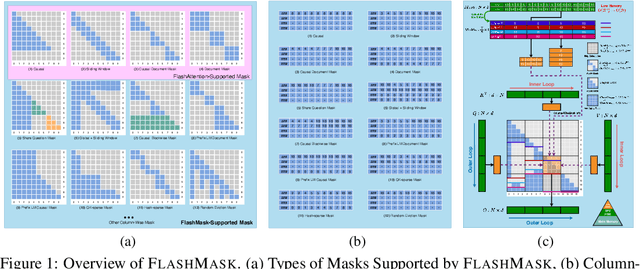
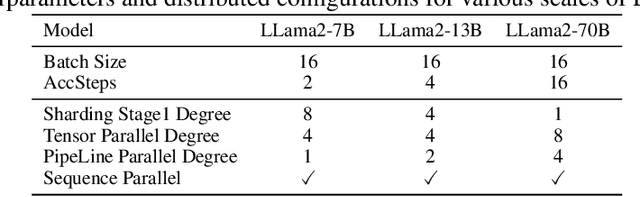
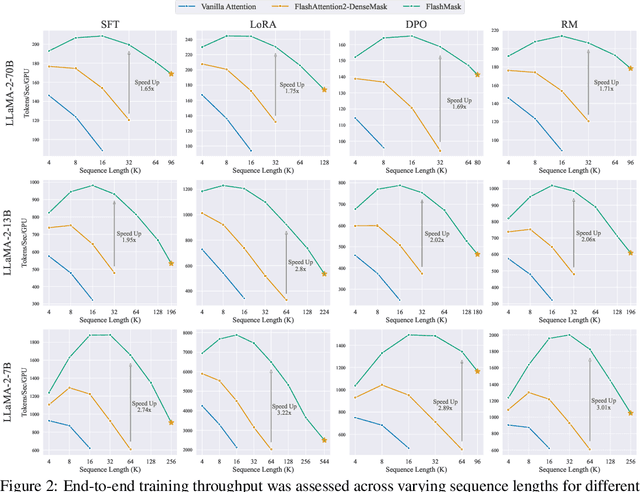

The computational and memory demands of vanilla attention scale quadratically with the sequence length $N$, posing significant challenges for processing long sequences in Transformer models. FlashAttention alleviates these challenges by eliminating the $O(N^2)$ memory dependency and reducing attention latency through IO-aware memory optimizations. However, its native support for certain attention mask types is limited, and it does not inherently accommodate more complex masking requirements. Previous approaches resort to using dense masks with $O(N^2)$ memory complexity, leading to inefficiencies. In this paper, we propose FlashMask, an extension of FlashAttention that introduces a column-wise sparse representation of attention masks. This approach efficiently represents a wide range of mask types and facilitates the development of optimized kernel implementations. By adopting this novel representation, FlashMask achieves linear memory complexity $O(N)$, suitable for modeling long-context sequences. Moreover, this representation enables kernel optimizations that eliminate unnecessary computations by leveraging sparsity in the attention mask, without sacrificing computational accuracy, resulting in higher computational efficiency. We evaluate FlashMask's performance in fine-tuning and alignment training of LLMs such as SFT, LoRA, DPO, and RM. FlashMask achieves significant throughput improvements, with end-to-end speedups ranging from 1.65x to 3.22x compared to existing FlashAttention dense method. Additionally, our kernel-level comparisons demonstrate that FlashMask surpasses the latest counterpart, FlexAttention, by 12.1% to 60.7% in terms of kernel TFLOPs/s, achieving 37.8% to 62.3% of the theoretical maximum FLOPs/s on the A100 GPU. The code is open-sourced on PaddlePaddle and integrated into PaddleNLP, supporting models with over 100 billion parameters for contexts up to 128K tokens.
The NiuTrans System for the WMT21 Efficiency Task
Sep 16, 2021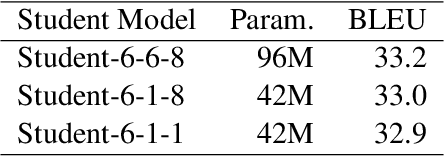
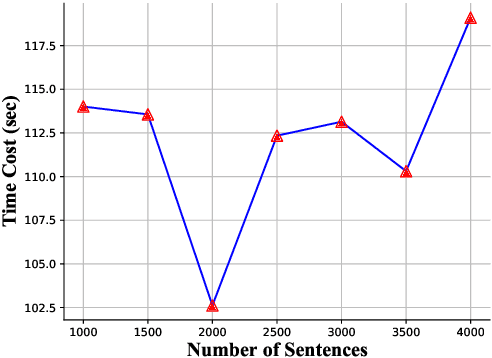

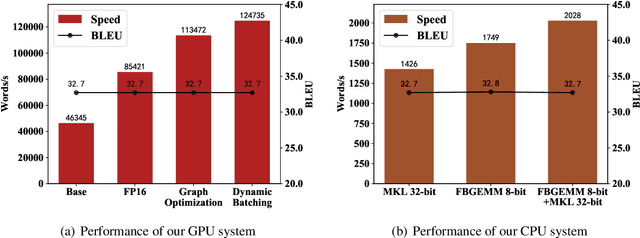
This paper describes the NiuTrans system for the WMT21 translation efficiency task (http://statmt.org/wmt21/efficiency-task.html). Following last year's work, we explore various techniques to improve efficiency while maintaining translation quality. We investigate the combinations of lightweight Transformer architectures and knowledge distillation strategies. Also, we improve the translation efficiency with graph optimization, low precision, dynamic batching, and parallel pre/post-processing. Our system can translate 247,000 words per second on an NVIDIA A100, being 3$\times$ faster than last year's system. Our system is the fastest and has the lowest memory consumption on the GPU-throughput track. The code, model, and pipeline will be available at NiuTrans.NMT (https://github.com/NiuTrans/NiuTrans.NMT).